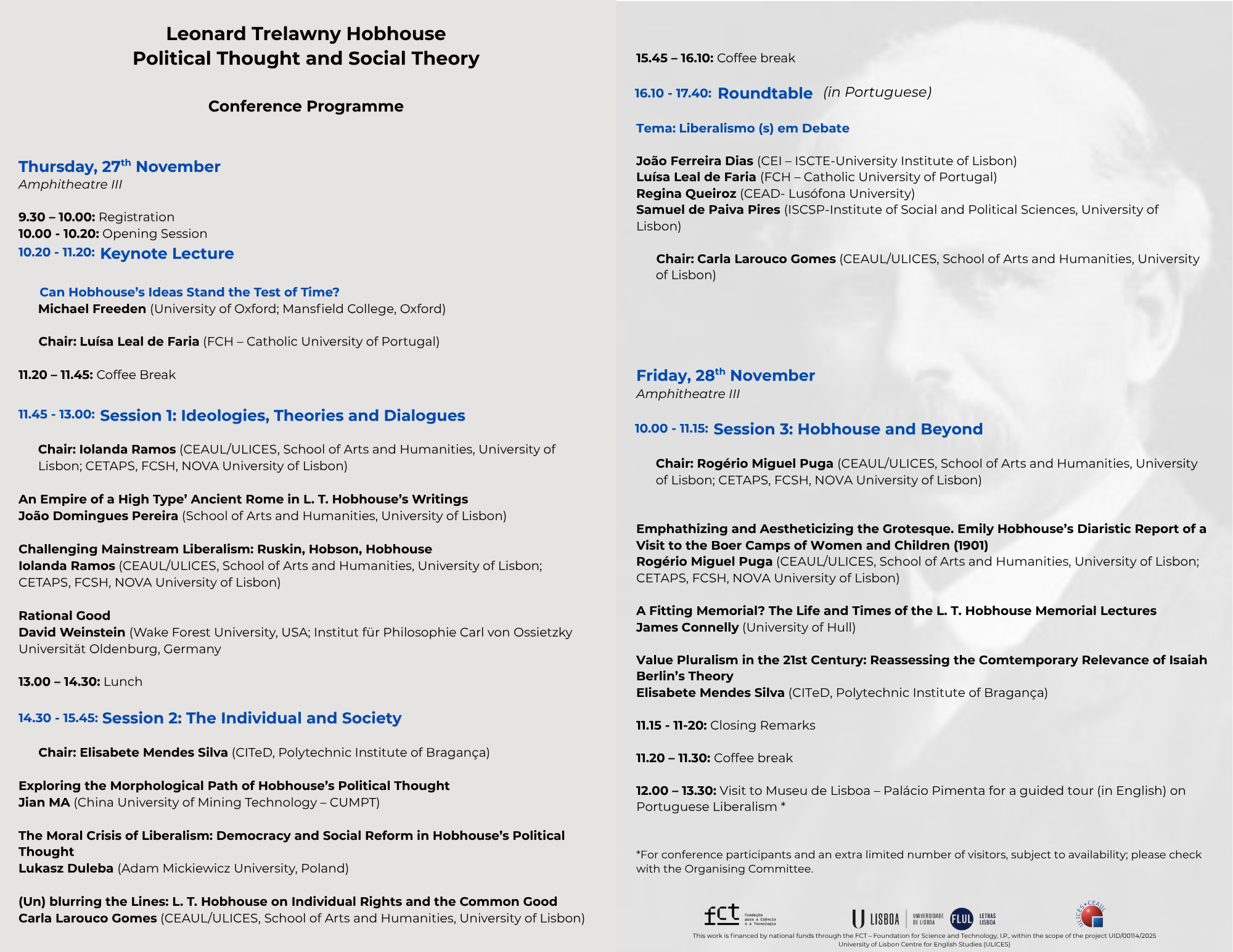
Leonard Trelawny Hobhouse | Political Thought and Social Theory
27 novembro 2025 00:00 - 28 novembro 2025 00:00
Data: 27 e 28 de Novembro de 2025
Local: Faculdade de Letras da Universidade de Lisboa
Organização: CEAUL - Centro de Estudos Anglísticos da ULisboa
Mais informações: hobhouse.lisbonconference@gmail.com | Neste Website
Inscrição obrigatória: (Early bird (until 15 September): 150 euros | Late Bird (16 September to 20 November): 175 euros | Students: 75 euros
Envio de propostas de comunicação até 13 de Julho de 2025
 CALL FOR PAPERS
Leonard Trelawny Hobhouse
Political Thought and Social Theory
27-28 November, 2025 University of Lisbon, School of Arts and Humanities,
Michael Freeden Emeritus Professor of Politics, University of Oxford and Emeritus Professorial Fellow, Mansfield College, Oxford.
Peter Clarke Emeritus Professor of Modern British History at Cambridge University and a former Master of Trinity Hall, Cambridge.
“Leonard Trelawny Hobhouse was the most sophisticated intellectual exponent of the ‘New Liberalism’ which emerged in Britain in the closing years of the nineteenth century.”
Such a sophistication, recurrently acknowledged throughout his career, was ultimately marked by his election as a Fellow of the British Academy a hundred years ago, in 1925.
Leonard Trelawny Hobhouse (1864-1929) was an extremely dynamic scholar and journalist, who wrote prolifically on a wide variety of subjects that were invariably closely related to the political and social reality of his time. Politics and sociology were, in fact, the two great fields that inspired most of the author’s writings. Besides having been a vigorous political thinker, Hobhouse was also one of the founding fathers of sociology in England and actually held the first Professorship of this discipline in the country.
In fact, within the ideological sphere, L. T. Hobhouse was one of the most relevant representatives of the new liberalism that gained shape in Britain in the last decades of the 19th century and which influenced the nature of politics in the 20th century, namely as far as the expansion of the welfare state is concerned. Moreover, in a context of great social instability, but also one of dynamic political and ideological debate, Hobhouse’s new liberalism promoted a belief in an organic conception of society characterised by a harmonious and cooperative relationship between the individual, the state and the community. His proposal implied a redefinition of the roles of these three entities, so as to allow for and foster individual development and the common good, both of which were of crucial importance for progress. We therefore find, in his political thought, the merging together of traditional liberal ideas, coupled with the expression of concerns of an imminently social nature.
Today, a hundred years over Hobhouse’s election as a fellow of the British Academy this conference aims at celebrating the author’s relevance within the sphere of British political thought, as well as his contribute in the field of sociology, by gathering together scholars from different areas of expertise.
We therefore welcome individual paper or panel proposals both on L. T Hobhouse and on his political and social context. Proposals should be sent to hobhouse.lisbonconference@gmail.com and include an abstract of 250-300 words, the author’s name, affiliation and email address, as well as a short bionote (circa 100-120 words).Panels of three to four and one discussant speakers should also include a general abstract introducing the theme of the panel.
The conference will take place at the University of Lisbon, School of Arts and Humanities. There will not be a virtual or hybrid option for this conference. Organisers expect to publish a selection of papers presented at the Conference. Suggested topics include, but are not limited to:
Hobhouse on liberty, democracy and equality;
Hobhouse’s definition of rights;
Hobhouse on the State, individual and society;
Hobhouse’s ethical dimension;
Hobhouse’s social theory/theory of harmony;
Hobhouse on the evolution of the mind and morals;
Hobhouse, S. Mill and T. H. Green;
Hobhouse, Hegel and Bosanquet;
Hobhouse and the Press;
Hobhouse and The Boer War;
Hobhouse and World War I;
The Oxford years: Hobhouse and the Fabians;
The New Liberalism and the Welfare State;
The New Liberalism and Imperialism;
The New Liberalism and the Scientific Theories of Evolution: progress, Social Darwinism and Eugenics;
The New Liberalism and Idealism The New Liberalism, Collectivism and Socialism;
The New Liberalism and Utilitarianism;
The New Liberalism: political theory and party politics;
The New Liberalism, Social Reform and the Budget of 1910;
Liberalism as a tradition and a historical phenomenon: T.Hobhouse, Isaiah Berlin, John Rawls;
The legacy of Classical Liberalism in the shaping of the New Liberalism; Hobhouse and the New Liberalism Today: legacies from the past;
*Meadowcroft, James (Ed.). (1994). Introduction. L. T. Hobhouse. Liberalism and other Writings. Cambridge: CUP. ix- xxvi.
Fees:
Early bird (until 15 September): 150 euros
Late Bird (16 September to 20 November): 175 euros Students: 75 euros
Organising Committee:
- Adelaide Meira Serras, CEAUL/ULICES, School of Arts and Humanities, University of Lisbon
- Carla Larouco Gomes, CEAUL/ULICES, School of Arts and Humanities, University of Lisbon
- Carlos Viana Ferreira, CEAUL/ULICES, School of Arts and Humanities, University of Lisbon
- Elisabete Mendes Silva, CITeD, Polytechnic Institute of Bragança
- Iolanda Ramos, CEAUL/ULICES, School of Arts and Humanities, University of Lisbon; CETAPS, FCSH, NOVA University of Lisbon
- Rogério Miguel Puga, CEAUL/ULICES, School of Arts and Humanities, University of Lisbon; CETAPS, FCSH, NOVA University of Lisbon
Scientific Committe:
- Adelaide Meira Serras, CEAUL/ULICES, School of Arts and Humanities, University of Lisbon
- Carla Larouco Gomes, CEAUL/ULICES, School of Arts and Humanities, University of Lisbon
- Carlos Viana Ferreira, CEAUL/ULICES, School of Arts and Humanities, University of Lisbon
- Elisabete Mendes Silva, CITeD, Polytechnic Institute of Bragança
- Iolanda Ramos, CEAUL/ULICES, School of Arts and Humanities, University of Lisbon; CETAPS, FCSH, NOVA University of Lisbon
- Luísa Leal de Faria, FCH – Faculty of Human Sciences, UCP – the Catholic University of Portugal
- Nelson Pinheiro Gomes, CEAUL/ULICES, School of Arts and Humanities, University of Lisbon
- Rogério Miguel Puga, CEAUL/ULICES, School of Arts and Humanities, University of Lisbon; CETAPS, FCSH, NOVA University of Lisbon
- Teresa Malafaia, CEAUL/ULICES, School of Arts and Humanities, University of Lisbon
Â